History of Prestwood Common
The following article has been researched and written by Dr Brian Roberts.
TWO ROODS AND TWENTY-ONE PERCHES
On the edge of Prestwood Common
This article discusses the land adjacent to the junction of Wycombe Road and Sixty Acres Road. See this interactive view of the location. (Google Maps)
Over much of central and eastern England the familiar land pattern of fields enclosed by hedges dates only from the middle of the eighteenth century or sometimes later. Before then much of the countryside was open land and even where some enclosure had taken place there remained large areas of ‘wastes’ and commons. The drawn out process of enclosing the land took more than a century to complete. In England and Wales it was enforced by a series of Acts of Parliament which by the middle of the nineteenth century, when the process was largely complete, had run into thousands. Some of the last areas to be enclosed were pieces of common land and these were covered by the General Inclosure Acts of 1845 and 1846. Among lands enclosed under these Acts were Prestwood and Kiln Commons in the parish of Great Missenden, which until then had been uncultivated open tracts of land, to which no-one claimed ownership.

Prestwood Common lay on the west side of Great Missenden parish adjacent to its boundary with Hughenden (or Hitchenden) parish. The western edge of the common extended from Collings Hanger Farm to Nanfans Grange, the northern boundary followed what is now Mote Lane, the eastern boundary is now marked by Nairdwood Lane and the southern boundary was approximately where Lodge Lane now runs. A track running north from Knives Farm where the road from Chepping Wycombe ended, crossed the Common and continued to Honor End with branches to the east towards Great Missenden. At 650 feet above sea level the area was one of the highest inhabited parts of the Chilterns.
August 1850 Enclosure of the Common
Situated just outside the western boundary, in Hughenden parish, were a number of houses with land which bordered the Common and which were approached from it. One of these houses was the property of Miss Caroline Vincent Mayhew and in August 1850 she acquired, under the provisions of the General Inclosure Acts, a piece of common land between the eastern boundary of her property and the track from Knives Farm to Honor End. This land, in area estimated to be ‘two roods and twenty one perches’ [1] gave her property a frontage on what became a public road from Wycombe to Missenden.
Miss Caroline Mayhew had inherited this property the previous year from her aunt, Miss Mary Mayhew, who died in 1848. She did not occupy the house herself (she lived at Loudwater) but leased it to tenants [2]. The house had already been long established, probably since 1710, but one story dates it from the seventeenth century when it was known as the Roundhouse and is said to have been used by Oliver Cromwell at the time of the Civil War. The addition of a small piece of the Common increased the area of the land attached to the property to about eight acres. For this additional piece of land (something over half an acre) Miss Mayhew paid the Inclosure Commissioners the sum of £22, entitling her to the “only proper use and behoof . . . . for ever” of the said piece of land. (see attachment below)
This sum seems trivial today but it is put in perspective by the tenancy agreement which Miss Mayhew drew up in February 1851 with Thomas West [3] , to whom she granted a fourteen year lease of her property at an annual rent of £30. Hence, the purchase price paid to the Inclosure Commissioners was equivalent in value to three quarters of a year’s rent that was payable for a substantial house and several acres of land. Today, that rent would amount to tens of thousands of pounds a year. Thomas West had to pay his rent in equal proportions twice a year, on Lady Day and at Michaelmas.
This piece of land bordering Wycombe Road lies on the north side of what is now a lane opposite the junction with Sixty Acres Road which extends to the footpath leading to Stony Green.
Owners and tenants
1856
Just over five years later (1856) Miss Mayhew sold her property to Henry Redrup of Prestwood, for £650, including the recently acquired piece of the Common. Henry Redrup was described as a baker [4] and he purchased the property, with Thomas West still as a sitting tenant, and a lease that had a further nine years to run. The conveyance entitled Redrup to the land indicated on the map below,

‘together with ‘all houses outhouses buildings barns stables yards or gardens and orchards hedges ditches trees mounds fences ways paths waters watercourses rights members and appurtenances’.
On this 1856 map the position of the Great Missenden/Hitchenden parish boundary represents the original western edge of Prestwood Common. The ‘two roods and twenty-one perches’ sold by the Inclosure Commissioners to Miss Mayhew were located between the parish boundary and the track from Honor End to Wycombe.
1864-1867
Shortly after completing his purchase, Henry Redrup took out a mortgage on the property with Richard Horwood, a farmer from Drayton Beauchamp near Tring, for £200 at an interest rate of 5% per annum. So, Henry Redrup was then receiving £30 a year in rent and was paying £10 a year in interest. This remained the situation until December 1864 when Henry Redrup took out an additional mortgage with Richard Horwood for £100 at the same interest rate as before. By this time Thomas West’s lease would have just about expired and there is no evidence of it having been renewed or of another tenant being found. Henry Redrup would have lost his rental income and at the same time had increased his interest payments to £15 a year.
It seems probable that Henry Redrup himself took up residence in the property from then on. However, he still appears to have been short of funds because two years later, in January 1867, he increased his mortgage with Richard Horwood by another £100 and also obtained a mortgage of £60 from Archibald White, a gentleman of Great Missenden. The total loans secured on the property now amounted to £460 all at 5% interest per annum. None of the mortgage agreements made any provision for repayment of the capital and they all appear to have been indefinite arrangements provided that the annual interest was paid when due. However, two years later everything changed when Henry Redrup sold out to the Reverend Thomas Evetts, and repaid his loans but continued to live in the house as a tenant.
The Reverend Thomas Evetts was at that time Rector of Monks Risborough. He owned other properties in the area and was well known as the first vicar of Prestwood from the time of the consecration of the new parish church in 1849 until he moved to Monks Risborough in 1864. He had been the principal benefactor of the new church, having donated more than £3,000 towards the building costs and provided the land, from his purchase of Knives Farm, on which to build it.
Henry Redrup’s financial position does not appear to have been very robust. He sold to Thomas Evetts, who already owned the adjoining property to the north, for £700 but had to repay loans plus outstanding interest to Richard Horwood of £440 – 5s – 9d and to Archibald White of £70 – 5s – 4d, leaving him with just £189 – 8s – 11d of his original £650 investment in the property of over twelve years before. His net return from the property for the nine years of the lease to Thomas West was only £20 per year.
September 1873
In September 1873 Thomas Evetts sold the property, that was still leased to Henry Redrup, to Charles Townsend who also owned the adjoining property to the south. Charles Townsend, a gentleman from Great Kingshill together with David Clarke, a gentleman from High Wycombe, paid £845 for the property. A plan of the property at this time shows the ‘two roods and twenty one perches’ that Caroline Mayhew acquired from the Inclosure Commissioners, to be described as ‘arable’. Other plots of land comprising the property were described as either pasture, orchard or garden.
1889
It is not clear for how long Henry Redrup retained the tenancy after this change of ownership but almost exactly sixteen years later, in September 1889, Charles Townsend granted a lease to Katherine Carter, wife of Butler Carter, Lieutenant R.N. rtd., of the Cottage, Prestwood. Mrs Carter’s lease states that the house was in the occupation of the lessee, i.e. Thomas Townsend, so Henry Redrup must have gone sometime before. This lease was to last for fourteen years at an annual rental of £40 payable in four equal quarterly amounts. The tenant also had to pay rates and was responsible for maintenance. The tenant had
to undertake to paint the exterior woodwork and ironwork with at least two coats of good oil colour in a proper and workmanlike manner; to paint those parts of the inside of the premises that are usually painted; to whitewash and colour those inside parts that are usually whitewashed or coloured; to paint, tar and pitch all gates rails and fences; and to ‘plash, scour, keep and leave in the best order the hedges, ditches, drains and fences’. No tree was to be cut down without permission, on penalty of £10 per tree, and the landlord had the right to inspect the property twice a year and give the tenant notice to carry out any necessary repairs. The painting had to be done twice during the duration of the lease, the second painting to be carried out in the year immediately before the expiry of the lease.
Whether or not Mrs Carter complied with any of these stipulations cannot be known because the lease also granted the tenant the right to purchase the property for £1,200 if due notice was given within five years of the lease being granted. Mrs Carter exercised this right just before the five-year period expired. However, before she did so there was another change in the ownership of the property. Charles Townsend, who moved from Prestwood to live at South Lawn, Acre Lane, Brixton, transferred the ownership of the property to his grandson, Charles Townsend Maxwell, gentleman, also of South Lawn, Brixton. This transfer was made in October 1891 and the property was conveyed ‘in consideration of the natural love and affection’ he held for his grandson and no financial exchange was involved. Charles Townsend died of cancer in Brixton in June 1893.
December 1895-1897
So, in December 1895, it was from Charles Townsend Maxwell that Katherine Carter purchased the property. In fact she only paid him £1,000 instead of the £1,200 stipulated in the lease and in a simultaneous transaction she then sold again to Charles William Goldsworthy Wood, a cornice, pole and blind manufacturer of Upper Baker Street, Marylebone, for £1,500. At the same time she surrendered her tenancy. This illustrates quite nicely the difference in value of a property purchased by a sitting tenant and one sold with vacant possession.
Charles Wood took out a mortgage for £1,000 with the Friends Provident Institution of Bradford at 5% per annum (the interest rate for mortgages and loans seems to have been stable for nearly fifty years) which was redeemed within two years when the property was sold yet again. One of the trustees of the Friends Provident Institution who signed the mortgage deed was a John Stephenson Rowntree [5], gentleman, of York.
The conveyance of the property from Charles Wood to Alan Cameron Gardner, gentleman, of Lee near Great Missenden, in November 1897, contains the first record of the property being referred to as ‘The Chestnuts’. It seems that Charles Wood had ceased to be a ‘cornice, pole and blind manufacturer’ and was now a ‘gentleman’ living at ‘The Chestnuts’. Alan Gardner paid £2,100 for the property which meant that Charles Wood had seen a 40% rise in its value in under two years.
A New Century
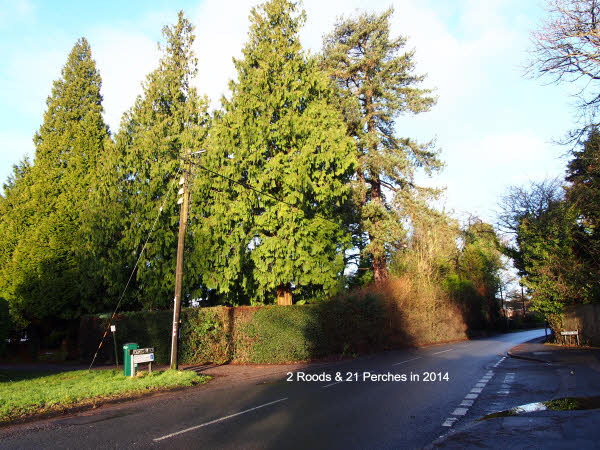
‘The Chestnuts’ now entered one of its more stable periods of ownership and was not to come on the market again for fifty five years. Alan Gardner died, at sea, in October 1934 but the property passed to his wife, Agnes, who continued to live there until her death in May 1951. During this time some improvements were made to the property, notably the building of a ‘gardener’s cottage’ known as ‘Little Chestnuts’. Many of the large trees that surround the property today and which can be seen from Wycombe Road were probably planted by the Gardners. An aerial photograph taken in 1945 and now viewable on Google Earth shows what was the ‘two roods and twenty-one perches’ to have been completely wooded at that time.
There were some legal complications on Agnes Gardner’s death because although ‘The Chestnuts’ was bequeathed to her by her husband and she had been granted probate as his sole executrix, she did not fully administer his will. Therefore, when she died, Letters of Administration were obtained by the National Provincial Bank who, acting as vendors, sold the property to Freda Bruce Lockhart, of Holland Street, Kensington, who immediately and in the same transaction sold to Albert Hayman and his wife, also Freda. Curiously, Freda Bruce Lockhart paid £5,750 but the Haymans only paid £5,000. The involvement of Freda Bruce Lockhart is unclear, nor is it apparent why she appears to lose £750. This is the same Freda Bruce Lockhart who frequently broadcast on the radio in the 1950’s as a film critic. The transaction was completed in October 1952 and included both the main house and ‘Little Chestnuts’.
1952-1957 Division and development
Albert Hayman of Road Farm, Great Missenden, is described as an estate agent and he and his wife retained ‘The Chestnuts’ until February 1957. In this year the Haymans divided the property and sold it as three separate lots. ‘The Chestnuts’ was sold to George Mennell, a builders’ merchant of West End Road, South Ruislip without ‘Little Chestnuts’ and without the piece of land with frontage onto the main road. A right of access to ‘The Chestnuts’ beyond the southern boundary was secured from the main road. ‘Little Chestnuts’ was sold to Hilda Beesley of Clarenden House Farm with a separate right of access along the northern boundary from the main road. A few months later a piece of land between the two access drives with a frontage on what was now known as Wycombe Road was sold to Alexander and Rachel Stark of ‘Green Acres’, Greenhill, High Wycombe. This piece of land was almost exactly equivalent to the ‘two roods and twenty one perches’ of Prestwood Common that Miss Mayhew had acquired from the Inclosure Commissioners for £22 one hundred and seven years before.
As a result of these deals the Haymans raised:
from ‘The Chestnuts’ £4550
from ‘Little Chestnuts’ £1150
from land bordering Wycombe Rd £1025
total £6725 – a 34.5% increase in five years.
Alexander Stark obtained planning permission in July 1958 for the erection of two houses or bungalows on the Wycombe Road plot but in December of that year he died. His widow then sold this land in January 1959 to Ernest (Edward) Roberts, a foreman carpenter of Lynhurst Crescent, Hillingdon for £1500. He divided the plot, amended the planning permission to allow two houses with garages and built, one on each plot (numbers 40 and 42). ‘The Chestnuts’ has since become known as ‘Chestnut Farm’.
Brian Roberts Feb 2000

References
Click on the image below to see a detailed image of a copy of the 1850 Conveyance from the Inclosure Commissioners.

The text in the document is reproduced below:
In the matter of the Great Missenden Inclosure (open to see detail)
Stamp duty
£1 – 15s
Buckingham
20.7.49
In the matter of the Great Missenden Inclosure
We William Blamire and George Darby Esquires the Inclosure Commissioners for England and Wales by virtue of an Act of Parliament passed in the eighth and ninth years of the reign of Queen Victoria instituted “An Act to facilitate the Inclosure and improvement of commons and lands held in Common the exchange of lands and the division of intermixed lands to provide remedies for defective or incomplete executions and for the non-execution of the powers of general and local inclosure Acts and to provide for the revival of such powers in certain cases” and in consideration of the sum of twenty two pounds paid into our hands by Caroline Vincent Mayhew of Loudwater in the County of Buckingham Spinster being the purchase money of the hereditaments hereinafter described do by these presents convey unto the said Caroline Vincent Mayhew her heirs and assigns All that piece or parcel of ground situate and being on Prestwood Common in the parish of Great Missenden in the County of Buckingham and containing by estimation two roods and twenty one perches bounded on or towards the north by waste lands on Prestwood Common aforesaid on or towards the East by the Public Road leading from Chepping Wycombe to Honnor End on or towards the South by waste land on Prestwood Common aforesaid and on or towards the West by ground and premises late the property of Mary Mayhew deceased and now of the said Caroline Vincent Mayhew the boundary fences to be made and forever hereafter maintained by the said Caroline Vincent Mayhew her heirs and assigns are those on the South and East sides of the said piece or parcel of ground hereby conveyed Together with the appurtenances to the said piece or parcel of ground belonging or appertaining To hold the said piece or parcel of ground with the appurtenances unto the said Caroline Vincent Mayhew her heirs and assigns To the only proper use and behoof of the said Caroline Vincent Mayhew her heirs and assigns for ever In Witness whereof we have hereunto affixed our seal this Sixth day of August one thousand eight hundred and fifty ——-
Received on the day and year last within written of and from }
the within named Caroline Vincent Mayhew the sum of } £22
twenty two pounds the consideration money within expressed to }
be paid by her to us ——–
Seal of the
Inclosure Commissioners
of England and Wales
G Darby Wm Blamire
Witness John Wm Tottie
(Copied from the original 1850 conveyance into private ownership for £22, of the common land on which 40 and 42 Wycombe Road have since been built.)
References from the Text
[1] 2 roods and 21 perches = 101 perches = 0.63 acre.
[2] Keen, D.J. Prestwood Historical Guide, The Prestwood Society, states occupant in 1850 to be James Watson ‘spirit merchant in London’.
[3] Ibid, Until 1850 Thomas West ‘farmer and also a jeweller in London’ was the tenant of Nanfans Grange, also owned by Miss Mayhew.
[4] Ibid. A bakery belonging to Jesse Redrup is described in Kiln Road.
[5] John Stephenson Rowntree (1834–1907) was a Director of Rowntree’s, the York confectionery company.
Next: 1850-1900 Prestwood